In the fast-paced world of industrial automation and advanced robotics, robotic arms are the “muscle” of the modern factory floor. From high-speed pick-and-place operations to precision assembly and quality sorting, smart robots rely heavily on their vision systems to interact with dynamic environments. However, pushing robotic arms to achieve human-like dexterity and speed exposes severe limitations in traditional machine vision hardware.
What is Arducam RoAD?
Your Fastest Path from Prototype to Production.
RoAD stands for Robotics of Arducam. It represents the path ahead. Taking a robot from a prototype on a lab bench to a fleet in the real world is a journey—one often blocked by the gap between fragile dev kits and expensive industrial sensors. Arducam RoAD is built to bridge that gap. We have evolved our 14 years of embedded vision DNA into a unified industrial ecosystem engineered for longevity. By combining developer-friendly flexibility with a guarantee of Long-Term Supply, Arducam RoAD ensures that the vision architecture you build today scales seamlessly to the machines you deploy tomorrow—and stays supported for years to come.
Today, we look at how our advanced camera series—featuring top-tier sensors like the Sony IMX900, ISX031, and AR0234—empowers industrial robotic arms with crystal-clear, mission-critical vision.
1. The Engineering Bottleneck: Five Major Vision Hurdles for Robotic Arms
As modern robotic applications demand higher throughput and smarter adaptability, traditional vision setups on robotic arms frequently break down under extreme operating conditions:
- High-Speed Motion & Motion Blur: Rapidly moving robotic joints cause severe motion blur and rolling shutter distortion in conventional cameras, making it nearly impossible to capture sharp imagery of fast-traveling parts.
- Complex and Dynamic Lighting: Factory floors experience fluctuating ambient light, harsh shadows, and LED flicker from facility lighting, which easily blinds standard sensors and causes data loss.
- Extreme Precision Requirements: Sub-millimeter tasks require ultra-high resolution and pixel-level accuracy; even a tiny visual distortion can lead to failed pickups or misaligned placements.
- Harsh Industrial Environments: Robotic arms undergo continuous mechanical vibration, dust, moisture, and long cable routing challenges that destabilize standard USB or consumer-grade cables.
- Growing AI Data Dependency: Modern robotic intelligence relies heavily on machine learning and AI inference. However, garbage-in means garbage-out; poor-quality, noisy inputs cripple downstream neural network accuracy.
2. Breaking the Deadlock: How Arducam RoAD Empowers Robotic Vision
To address these five core challenges, the Arducam RoAD series is engineered from the ground up to deliver uncompromising image acquisition and high-speed data transmission:
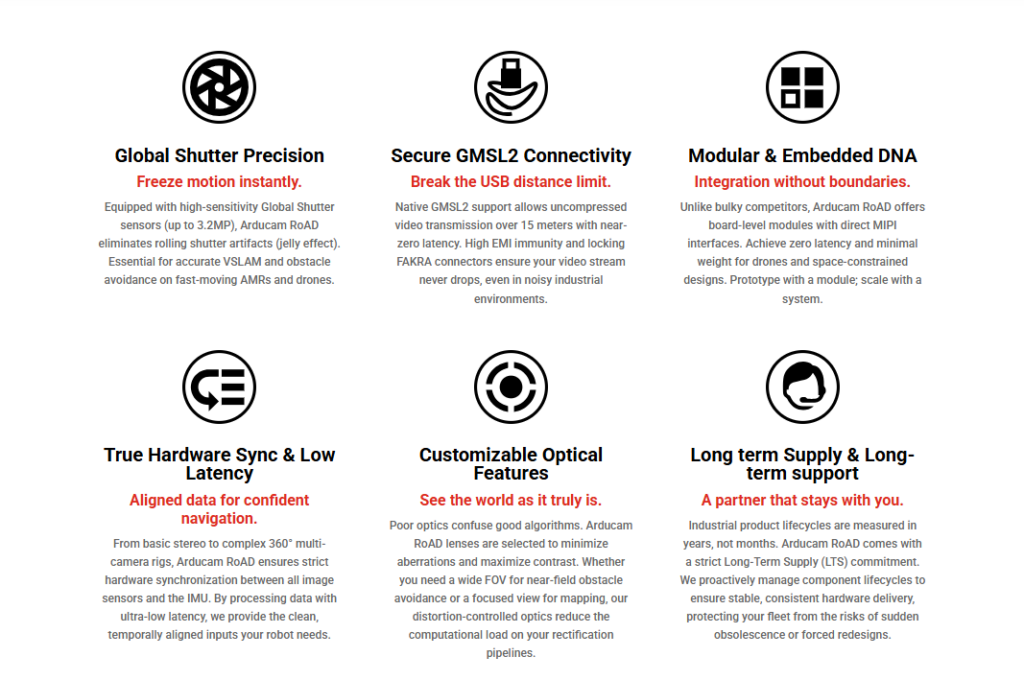
- Motion-Free (Global Shutter & High Frame Rate): Utilizing advanced global shutter sensors (such as the AR0234 and IMX900), the RoAD series eliminates rolling shutter artifacts and motion blur entirely, freezing fast-moving components instantly even at high operational speeds.
- Extreme HDR for Complex Lighting: Built-in multi-exposure HDR capabilities (such as the ISX031 technology boasting up to 120dB HDR and LED flicker mitigation) ensure flawless visibility under extreme contrast, heavy shadows, or flickering factory LED lights.
- High Resolution for Precision Detail: Crystal-clear imaging pipelines capture microscopic tolerances and structural details, giving robotic arms the precise visual feedback required for high-accuracy tasks.
- Industrial Reliability & Long-Distance GMSL2 Transmission: Leveraging robust GMSL2 technology and high-grade connectors, RoAD solutions support long-range cable extensions (up to 15 meters) with zero data packet loss, easily withstanding mechanical wear, twisting, and harsh factory environments.
- Better AI Input (The Ultimate Visual “Feed”): As a pure high-performance image acquisition and transmission specialist, the RoAD series does not perform AI processing itself. Instead, by providing a pristine, high-purity, distortion-free, and motion-blur-free visual source, it feeds the highest-quality data to backend AI algorithms and edge computing platforms, dramatically boosting model inference accuracy and reliability.
3. Product Spotlight: High-Performance Camera Modules for Robotic Arms
To match diverse mechanical payloads, interface requirements, and sensor preferences, the Arducam RoAD ecosystem and allied high-performance lines offer versatile, field-proven deployment options:
🌟 1. Sony IMX900 Color Global Shutter Binocular Synchronized Kit
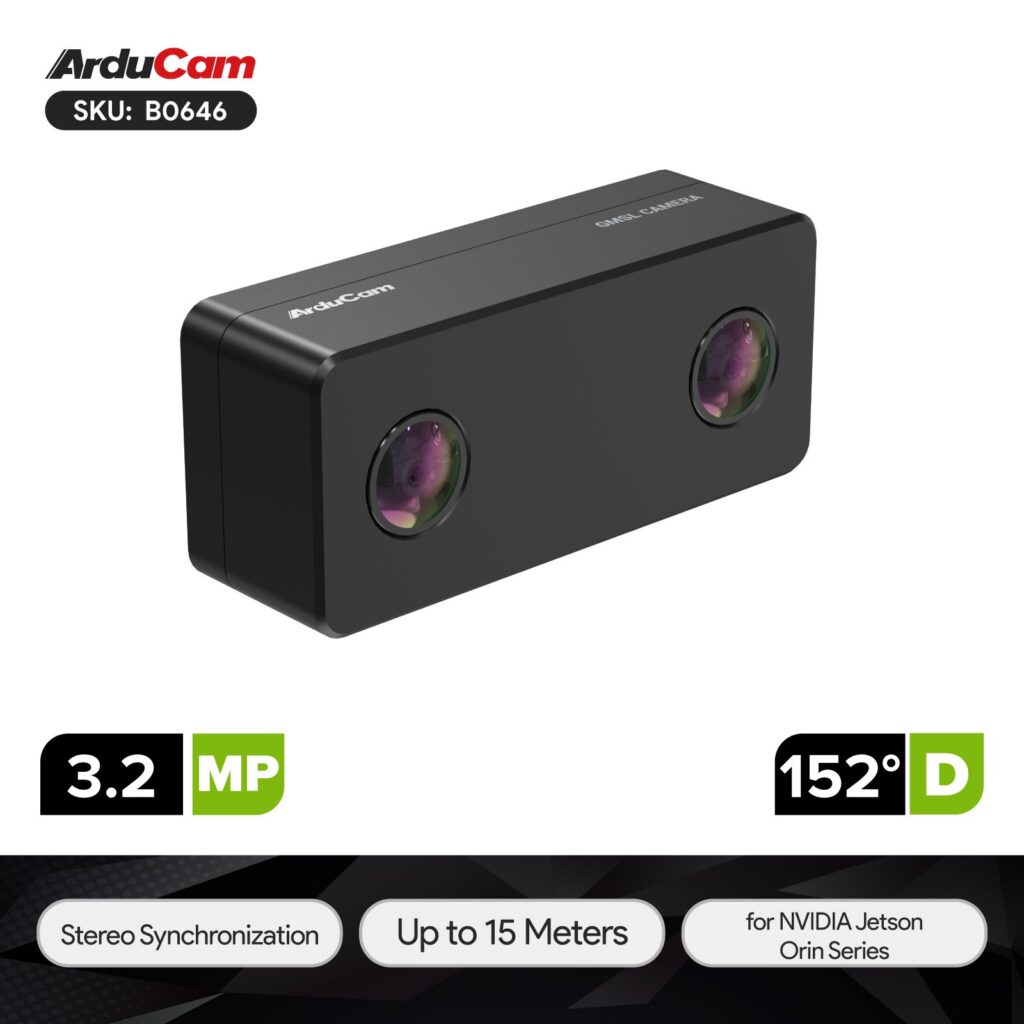
- Highlight: Built around the Sony IMX900 color global shutter sensor, this binocular synchronized GMSL camera kit delivers exceptional depth perception and zero-motion-blur stereo vision, tailored specifically for precision robotic guidance.
- Learn More: Arducam IMX900 Binocular Synchronized GMSL Camera Kit
🌟 2. Sony ISX031 High-Dynamic-Range Industrial Solutions
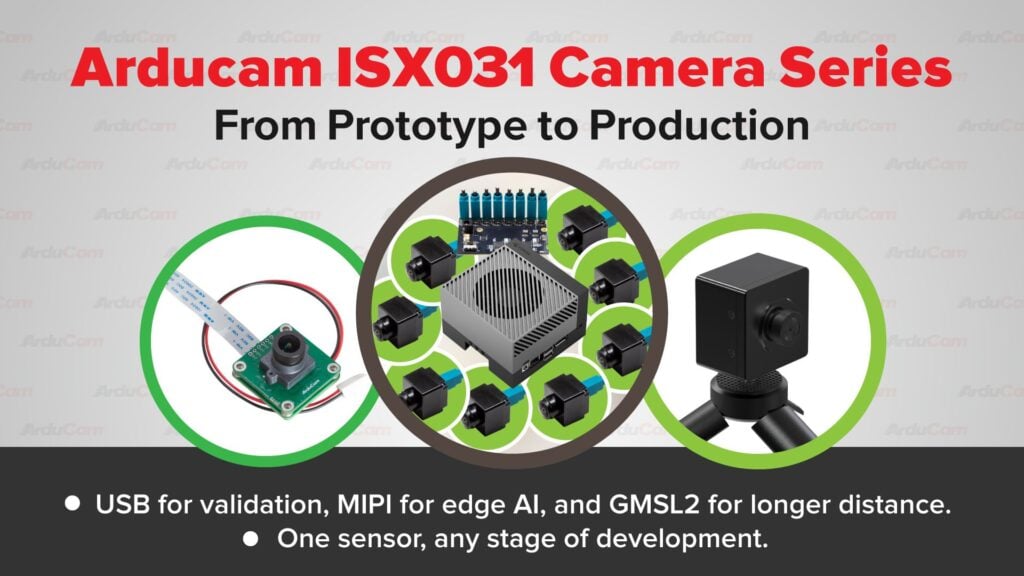
- Highlight: Featuring 120dB extreme HDR, built-in ISP, and advanced LED flicker mitigation (LFM), the ISX031 sensor lineup is built to conquer complex, high-contrast factory lighting. Available in multiple versatile form factors:
- MIPI Interface for Jetson: 3MP ISX031 MIPI Camera for NVIDIA Jetson Orin Nano/NX
- USB3 Plug-and-Play: 3MP ISX031 USB3 UVC Camera
- Rugged Multi-Channel GMSL2 Waterproof Kit: 3MP ISX031 8-Channel GMSL2 Camera Kit for Jetson AGX Orin (IP67, 15m Extension)
🌟 3. AR0234 Global Shutter & Multi-Camera Bundle Kits for Robotics
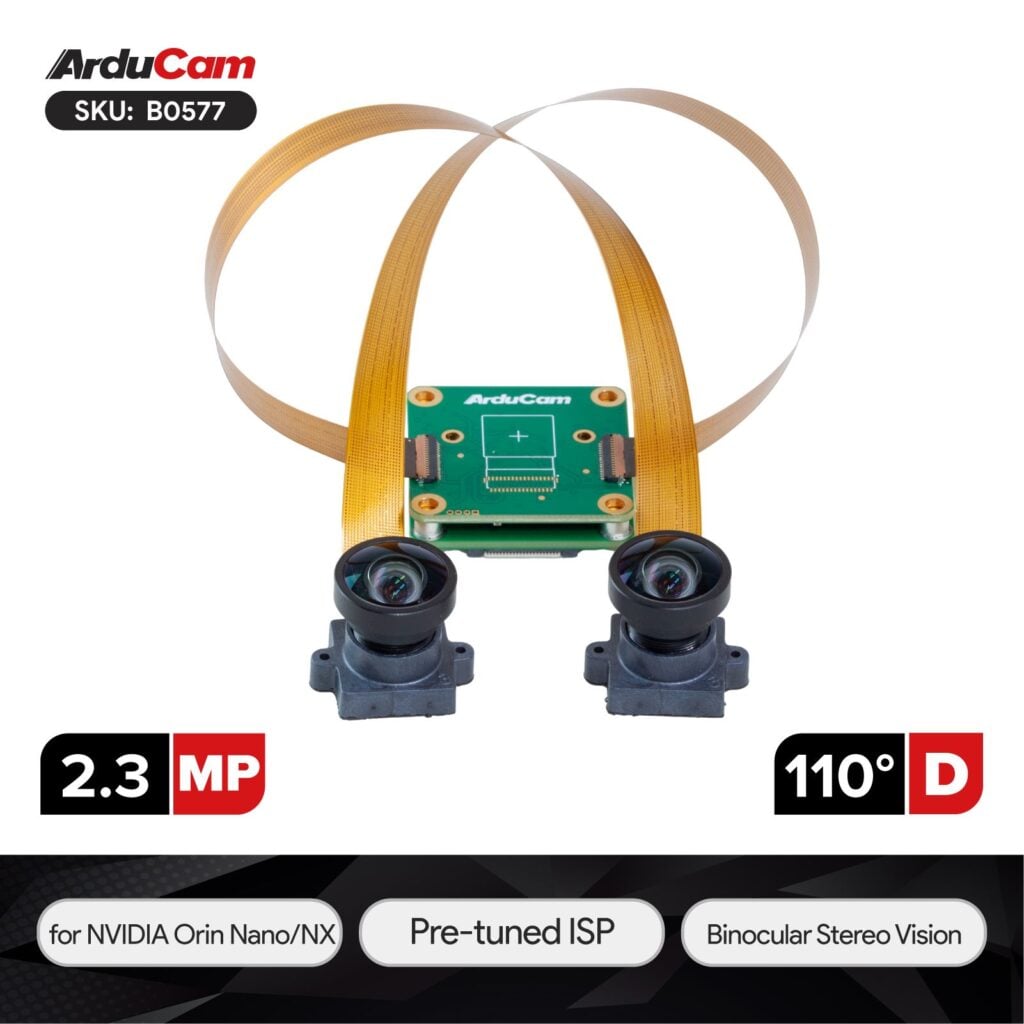
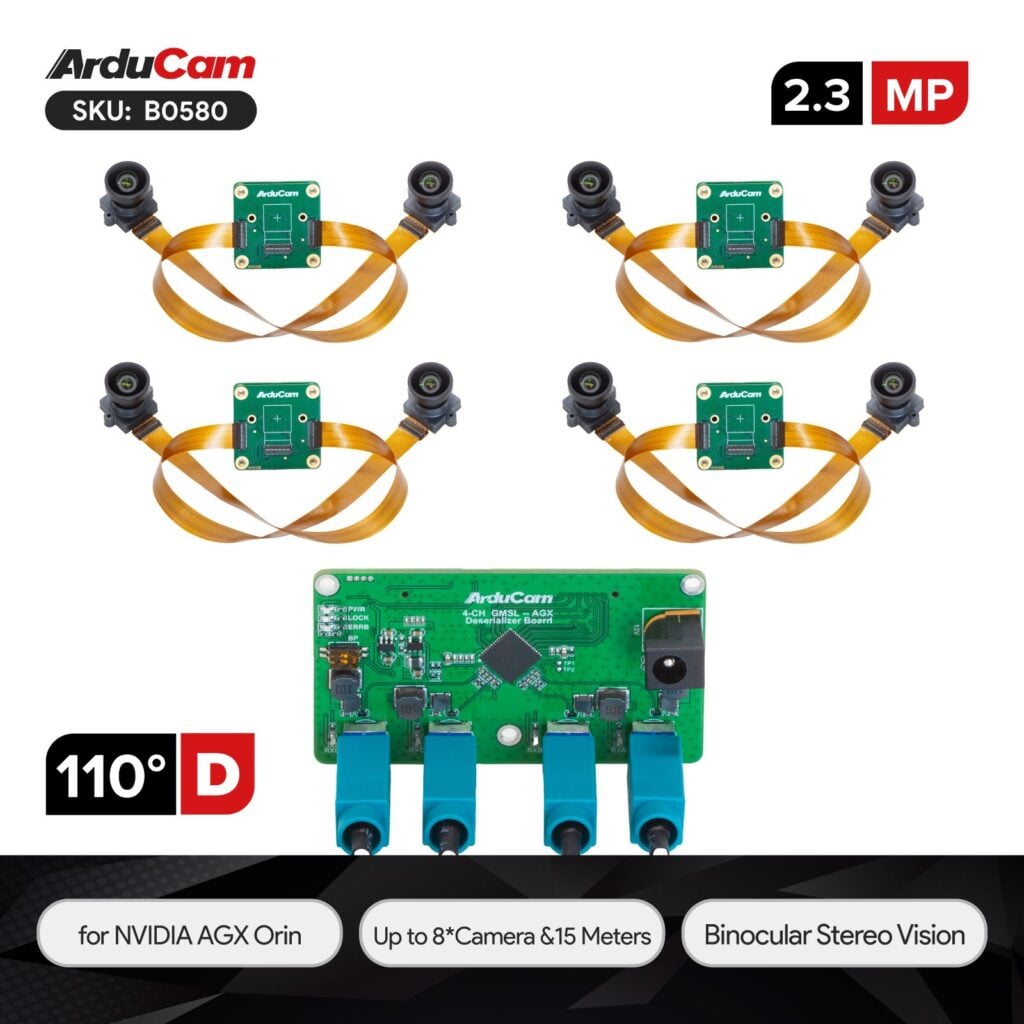
- Highlight: Designed natively for NVIDIA Jetson platforms, these kits harness high-resolution global shutter sensors (such as the 2.3MP AR0234) with onboard ISP to deliver synchronized stereo or multi-camera setups with zero motion artifacting.
- Explore Bundles:
- Sync Stereo Global Shutter Dual Camera Bundle for Jetson Orin
- 4-Channel Multi-Camera Bundle Kit for NVIDIA Jetson Orin Nano/NX
- For a comprehensive overview of our robotics vision framework, explore the Arducam RoAD Robotics Vision Solution Overview.
Looking to take your robot from prototype to scale with motion-free, industrial-grade image acquisition? 👉 Explore the links above to review detailed specifications, check developer compatibility, or connect with our engineering team for a customized robotic vision integration.