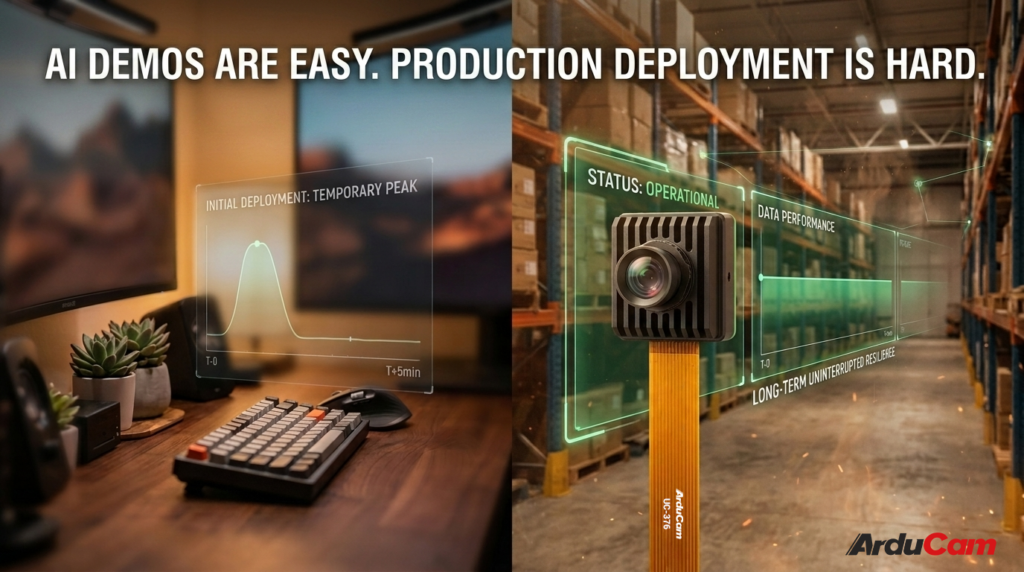
AI Demos Are Easy. Production Deployment Is Hard.
Artificial intelligence has dramatically lowered the barrier to building sophisticated computer vision systems. Today, developers can run complex object detection, classification, and tracking models directly on edge devices—often within hours of unboxing new hardware.
Getting an AI camera to perform flawlessly for a brief demonstration has never been easier.
Getting it to work reliably for months—or even years—in the field is an entirely different challenge. As Edge AI transitions from experimental prototypes to mission-critical production deployments, reliability is becoming just as vital as intelligence. In fact, it is often the single factor that determines whether a commercial AI project succeeds or quietly fails.

The Massive Gulf Between a Demo and a Product
Most AI vision systems begin their life cycle in highly controlled, forgiving environments:
- A development board sits comfortably on an office desk.
- Ambient temperatures remain strictly regulated by HVAC systems.
- Airflow around the components is entirely unrestricted.
- Engineers are on standby to monitor every frame and reboot the system if needed.
Under these pristine conditions, almost any system can appear stable. Production environments, however, are rarely so accommodating.
Whether deployed inside a busy logistics warehouse, a heavy industrial factory, a remote security installation, or an autonomous mobile robot (AMR), an AI camera must operate continuously while absorbing relentless environmental stress:
- Elevated Ambient Temperatures: Confronting baking summer heat or factory floor thermal spikes.
- Choked Airflow: Sealed tightly inside compact, dust-proof enclosures.
- Environmental Pollutants: Accumulating layers of dust and grime over lenses and heatsinks.
- Mechanical Vibrations: Sustaining constant shocks from nearby machinery or robotic movement.
- Continuous Heavy Workloads: Running intensive model inference cycles 24/7 without a break.
The harsh reality of hardware engineering is that critical limitations often emerge weeks or months after a prototype has been approved.
When Heat Becomes the Enemy of Intelligence
Thermal management is arguably one of the most overlooked bottlenecks in modern Edge AI design.
Every AI workload is computationally expensive and inherently generates heat. As continuous inference processes run, system temperatures steadily climb. Without a sophisticated, proactive thermal architecture, these elevated temperatures trigger a domino effect of system degradations:
- Thermal Throttling: The processor automatically cuts clock speeds to protect itself, causing frame rates to drop.
- Inference Fluctuation: Dropped frames lead to lagging pipelines and erratic AI model behavior.
- System Stalls: Extreme heat accumulation results in unpredictable freezes or unexpected reboots.
- Hardware Wear: Prolonged exposure to high thermal stress drastically reduces the lifespan of delicate electronic components.
💡 The Hardware Paradox: In many failed deployments, the AI model itself is blamed for inconsistent accuracy, when the true culprit is silent, unmanaged thermal instability.
For production-ready systems, thermal performance cannot be measured by peak benchmark bursts alone. It must be evaluated by how consistently the system maintains its cooling efficiency under a relentless, compounding workload over long-term operations.
Reliability Is a Multi-Dimensional Metric
While managing heat is paramount, field reliability extends far beyond a simple temperature reading on a datasheet. A truly deployable vision system must maintain stable operation across a spectrum of unpredictable real-world variables.
Before moving from a prototype to a commercial rollout, product teams must ask harder deployment questions:
- Can the hardware architecture sustain maximum inference loads indefinitely?
- How does the system’s power consumption and accuracy curve change after hundreds of hours of non-stop operation?
- Can the connection interfaces tolerate constant temperature fluctuations without signal degradation?
- Is the physical form factor ruggedized against constant industrial vibration and dust ingress?
These structural considerations rarely make it onto flashy benchmark charts, yet they carry the heaviest weight in real-world deployments.
The Hidden, Compounding Cost of Downtime
In the enterprise and industrial sectors, Edge AI reliability is directly tied to financial and operational outcomes.
- A security camera that drops frames due to thermal throttling creates blind spots and liability.
- An automated quality inspection line that freezes can instantly halt an entire manufacturing workflow.
- A logistics robot that loses its vision pipeline unexpectedly interrupts warehouse operations and demands manual intervention.
The total cost of field maintenance, system downtime, and damaged client trust often far exceeds the initial cost of the vision hardware. This is why industrial users are shifting their evaluation metrics: they no longer buy the fastest chip; they buy the most operationally stable platform.
The most sophisticated AI model in the world delivers exactly zero value the moment the system stops running.
Engineering for Uninterrupted, Long-Term Operation
At Arducam, we believe that Edge AI hardware should be validated under the exact same unforgiving conditions it will face in the field. That core philosophy directly guided the development of our IMX500 MIPI AI Camera.
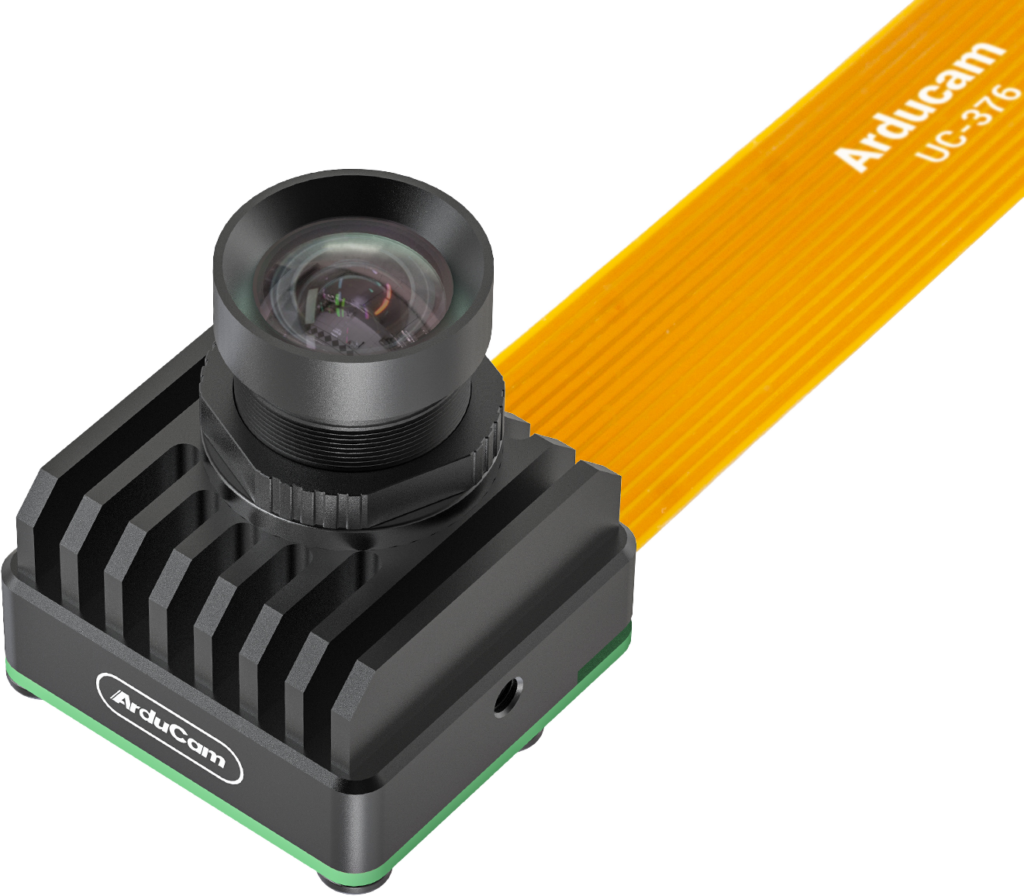
Rather than engineering strictly for brief bursts of peak performance, our development team prioritized long-term thermal resilience and passive dissipation architecture:
- Optimized Thermal Signature: Under continuous, intensive AI workloads, the camera module maintains a remarkably lean ~35°C temperature profile (measured in standard ambient conditions).
- Built for the Long Haul: The module is designed from the ground up to endure long-duration, non-stop industrial stress testing, validating that stable AI inference and structural integrity remain uncompromised over extended operational cycles.
While no single lab test can replicate every chaotic deployment environment, engineering for continuous, low-temperature endurance provides the baseline confidence required for demanding industrial applications.
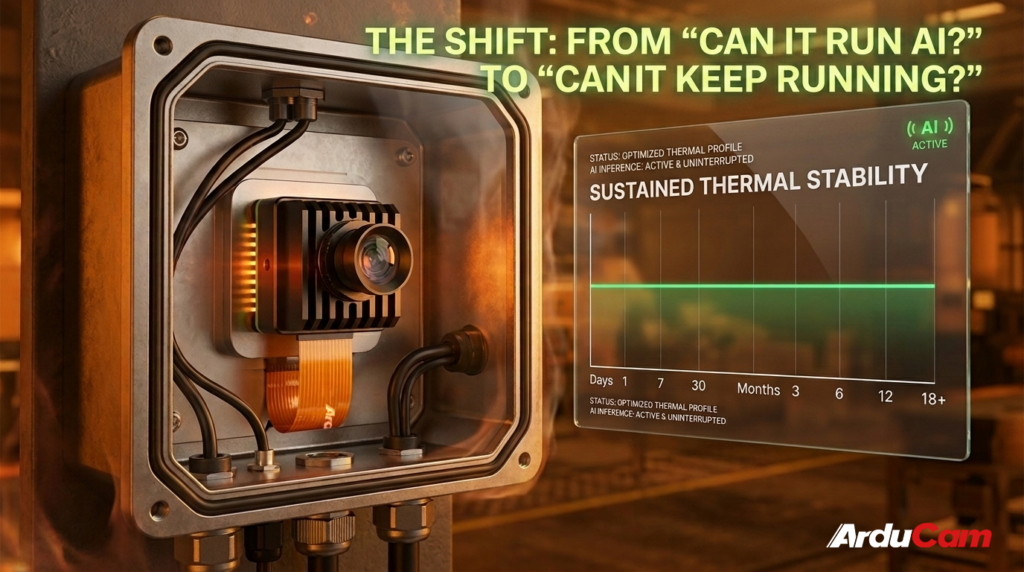
The Shift: From “Can It Run AI?” to “Can It Keep Running?”
As the Edge AI ecosystem matures, the industry conversation is undergoing a fundamental shift.
A few years ago, the primary question was proof of capability: “Can we successfully run an AI model on a compact edge device?” Today, the industry has moved past that milestone. The defining question of the production era is: “Can our Edge AI system operate reliably, autonomously, and continuously in a brutal environment when nobody is watching?”
The future of machine vision will not be defined solely by adding more TOPS or larger neural networks. It will be shaped by meticulous thermal engineering, ruggedized hardware form factors, and an absolute commitment to operational stability.
Because successful Edge AI products are not measured by how impressive they look during a 5-minute boardroom demo. They are judged by their ability to run silently, reliably, and indefinitely in the field.
Conclusion: Reliability is a Core Requirement
When evaluating an AI camera module for your next commercial rollout, benchmark scores and framework compatibility are only the first few lines of the equation.
Thermal behavior under stress, structural ruggedness, and long-term continuous operation must be treated as primary design constraints from day one. In real-world deployments, operational reliability isn’t a premium feature you add later.
It is the foundational requirement.