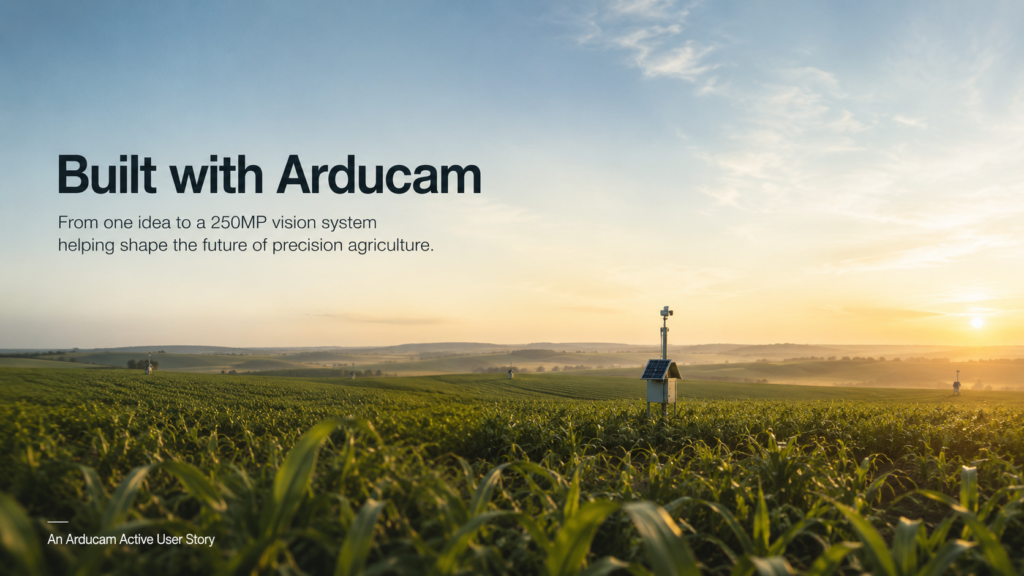
“Before I had a prototype, before I had proof, I contacted Arducam.”
Every ambitious engineering project begins long before the first line of code or the first piece of hardware. It begins with an idea—one that may sound impossible to everyone except the person determined to build it.
This is the story of Joshua Lorber, founder of SOMERA, and TerraScope—an ambitious distributed Earth observation system designed to provide high-resolution ground imagery for next-generation precision agriculture.
It is also the kind of story that reminds us why the Arducam Active User (AAU) Program exists.
When an Idea Needs More Than Components
TerraScope was created to solve a growing challenge in modern agriculture.
While satellite imagery offers tremendous coverage, farmers and researchers still lack affordable, scalable, field-level visual data that can accurately validate what satellites observe from space. TerraScope aims to bridge that gap by combining distributed ground imaging with satellite data to provide reliable, real-world information for crop monitoring and agricultural decision-making.
The vision is anything but small.
The project is being developed through a transdisciplinary consortium of 13 partners across 10 countries and four continents, with plans for large-scale deployment across European agricultural sites. Following prototype validation, the roadmap targets more than 6,000 field nodes operating in real-world environments.
But when Joshua first approached Arducam, none of that existed yet.
There was no finished prototype.
No field deployment.
No proof that the concept would work.
There was only an idea—and the determination to build it.
Building Together Through the AAU Program
When Joshua shared his vision with us, he wasn’t asking for sponsorship.
He was looking for a partner willing to take the journey with him.
Through the Arducam Active User (AAU) Program, we provided a 64MP Autofocus Synchronized Quad-Camera Kit to help validate the concept. More importantly, we began a technical collaboration that has continued for nearly two years.
As Joshua later reflected:
“Arducam engaged with my project from day one, with the same seriousness they bring to any partner. One person with an idea, and a team that responded as if it already mattered.”
Those words mean more to us than any product specification.
Because the purpose of the AAU Program has never been simply to provide hardware.
It exists to help innovative developers, researchers, startups, and creators transform promising ideas into working solutions that can make a real impact.
Turning Four Cameras into One Extraordinary Image
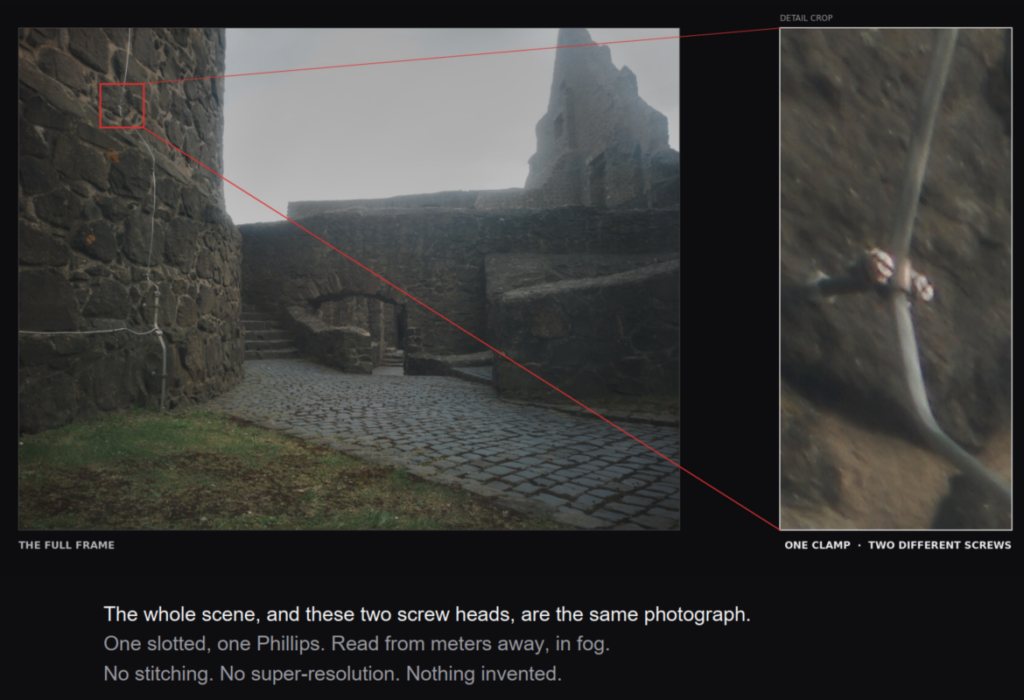
The prototype built around the Arducam Quad Camera Kit demonstrates exactly what careful engineering can achieve.
Using four synchronized 64MP camera modules connected to a single Raspberry Pi 5, Joshua developed a system capable of producing a 250-megapixel synchronized image from a single exposure.
What makes the achievement particularly compelling is its philosophy.
No AI-generated detail.
No super-resolution.
No stitched panoramas.
Just synchronized capture of real sensor data.
As Joshua describes it:
“250 Megapixels. One Raspberry Pi 5. Zero AI.”
The result is an imaging system designed to preserve what was physically present in front of the lens—something especially valuable for scientific observation, environmental monitoring, and long-term agricultural analysis.
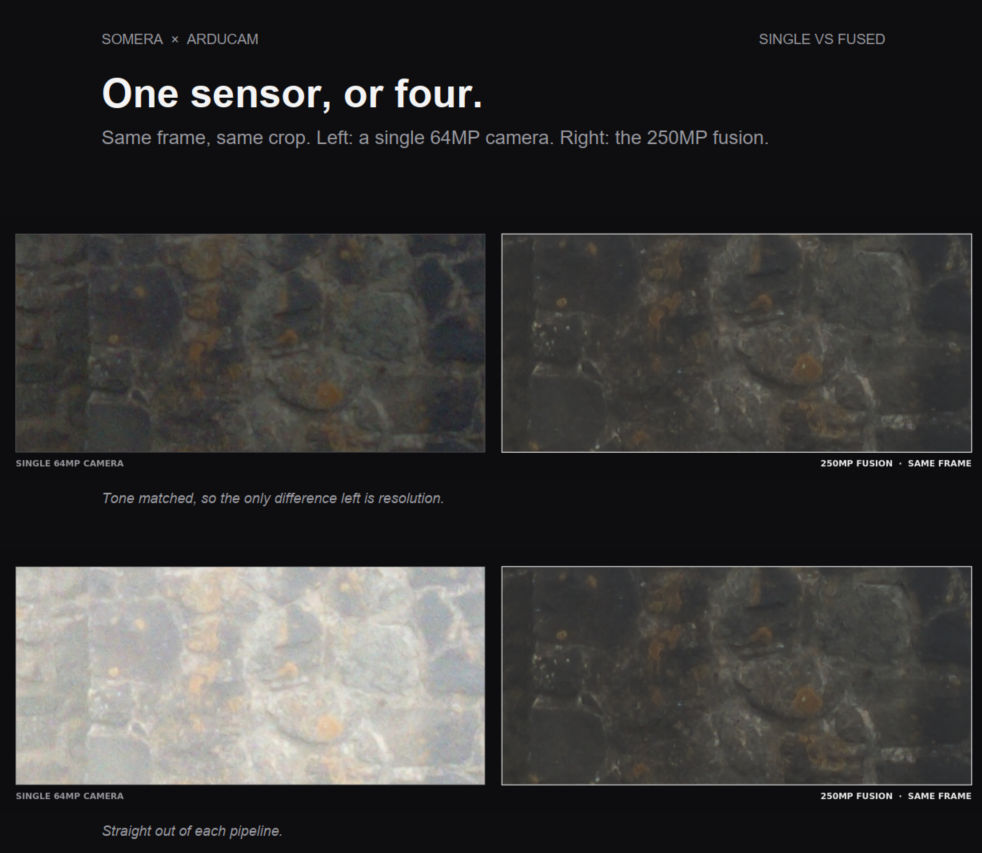
Single vs Fused
Designed for the Field, Not Just the Lab
High image quality alone wasn’t enough.
TerraScope’s imaging nodes are intended to operate autonomously in real agricultural environments under changing weather, varying light conditions, and without external power.
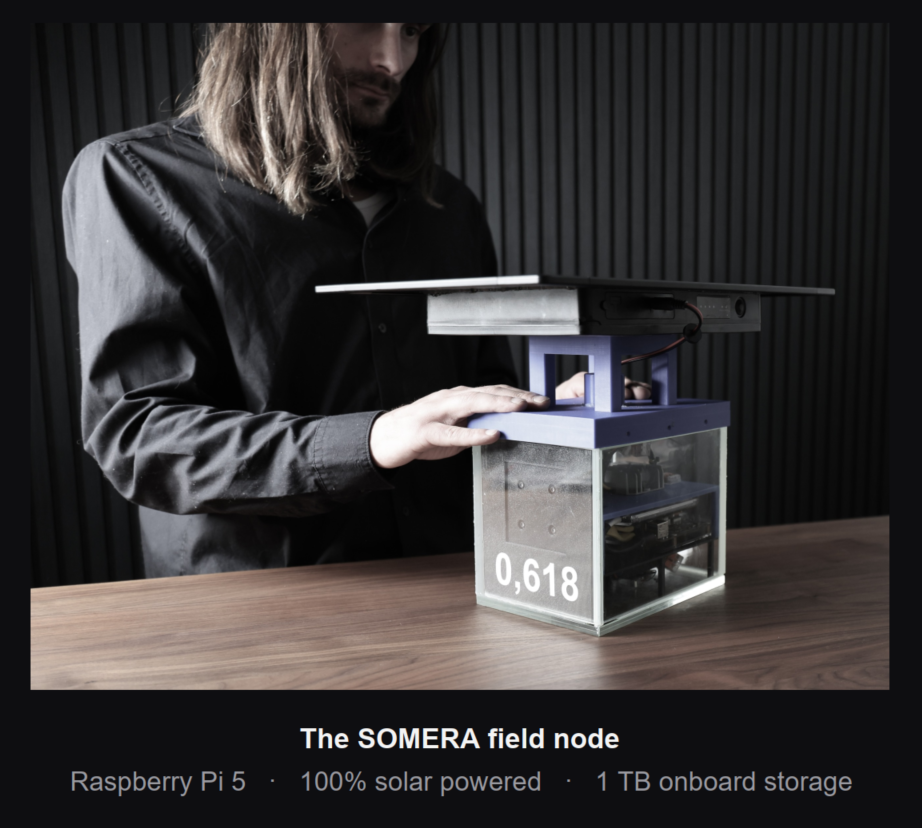
Each field node combines a Raspberry Pi 5, synchronized Arducam 64MP camera modules, onboard storage, and solar power into a system designed for continuous outdoor deployment.
For the project team, selecting the camera platform wasn’t simply about resolution.
It was about finding a solution that combined image quality, synchronization capability, Raspberry Pi compatibility, compact design, and affordability.
As stated in the original project proposal:
“The Arducam 64MP autofocus module addresses both requirements, offering the resolution, form factor, and Raspberry Pi compatibility that no comparable sensor provides at this price point.”
Beyond a Prototype
Today, the prototype has moved beyond concept validation.
It is being integrated into infrastructure supporting future agricultural monitoring initiatives, with a roadmap toward significantly larger deployments.
For Joshua, the journey has also been deeply personal.
He shared something with us that perfectly captures why stories like this matter:
“When I first shared my vision, someone told me to stick to painting.”
“I used to be a scenic painter and now I build with Arducam.”
Innovation often begins with people willing to imagine something others cannot yet see.
Sometimes, all they need is the opportunity to prove it.
Why We Built the AAU Program
People often ask what success looks like for the Arducam Active User Program.
Of course, we’re happy when someone chooses our cameras.
But that’s never been the ultimate goal.
The real success is seeing those cameras become part of something bigger—a scientific instrument, a conservation project, a medical device, a robot, or, in this case, a distributed vision system designed to help feed a growing world more intelligently.
Stories like TerraScope remind us that embedded vision isn’t only about sensors, interfaces, or megapixels.
It’s about the people building with them.
And if the AAU Program can help even one more creator turn an ambitious idea into something that benefits society, then we’ve accomplished exactly what we set out to do.
Because at Arducam, we don’t just build cameras.
We help people build what’s next.